| 👉 In partnership with Campaign Monitor 
Campaign Monitor is a cloud-based email marketing platform designed to help businesses create, send, and optimize professional email campaigns. It offers intuitive drag-and-drop design tools, audience segmentation, and detailed analytics to help marketers build stronger connections with their subscribers. Campaign Monitor's AI-driven capabilities have further enhanced its effectiveness in modern marketing. Through the use of artificial intelligence and machine learning, the platform helps businesses send more personalized and timely messages, improving engagement and conversion rates. AI is deeply integrated into Campaign Monitor's automation, optimization, and reporting systems, allowing marketers to make smarter, data-backed decisions about their email strategies. - Smart Email Automation: Uses AI to send emails at optimal times with personalized content for higher engagement.
- AI-Enhanced Reporting and Insights: Uses AI to analyze performance, identify trends, and recommend improvements for optimized marketing results.
| | 🚀 Two AI Winners: OpenAI Takes SMBs, Anthropic Wins Big Business 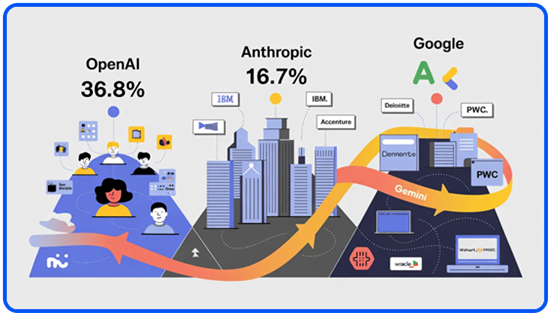
Brief Buzz: OpenAI is dominating small and mid-sized business (SMB) AI spending - but the enterprise race tells a different story. New billing data highlights OpenAI's lead today, while rivals Anthropic and Google lock in heavyweight corporate partnerships that could reshape the market long-term. - OpenAI leads AI spend on Ramp, used by 36.8% of Ramp customers
- Anthropic follows at 16.7%, while gaining ground in large enterprises (ZDNet analysis)
- Anthropic has landed major deals with IBM, Deloitte, Accenture, Cognizant, Allianz, and Travelers
- Google appears low in spend, but Gemini is deeply embedded at Walmart, Oracle, and PwC
- OpenAI's broad strategy spans health apps, translation, and even neurotech investments (ChatGPT Health, Translate, Merge Labs)
Why Should You Care?
This rivalry shapes which AI tools show up at your workplace, how reliable they are, and how much they cost. OpenAI's early SMB dominance helps startups move fast—but Anthropic's enterprise focus and Google's workplace reach could define the AI you'll actually use day-to-day. More competition = better, cheaper, faster AI for everyone. | | ⚡️ 5 AI Tools to Supercharge Your Productivity 👉 NinjaOne - harnesses artificial intelligence to simplify endpoint management, patching, and overall IT operations. Its AI stack focuses on turning the flood of patch data and device telemetry into precise, actionable guidance for busy IT teams. 👉 ActivTrak - AI-powered workforce-analytics engine auto-classifies every app & website activity to reveal focus vs distraction trends and productivity baselines. Predictive coaching dashboards surface "nudges" for managers, using ML to flag at-risk teams and recommend schedule or workload tweaks. 👉 RemotePC is a remote access solution that allows users to connect and control computers from any location. Its AI-driven features include automatic session optimization, providing seamless performance by adjusting to network conditions. 👉 Human Interest - The platform uses AI-driven compliance intelligence to continuously monitor regulatory requirements, automatically flag anomalies, and reduce the administrative burden associated with plan oversight. 👉 SBG Funding - Although primarily a small-business lender, SBG Funding publishes guidance on how its clients are using AI and ML tools for growth — and by extension SBG helps finance adoption of such AI-driven tech. | | 💻 3 Tutorials to Level Up Your Skills 
- Claude Code and Replit masterclass: Devs can learn how to streamline their workflow by combining Claude Code with Replit. You will learn to bypass complex local environment setups using cloud sandboxes for instant deployment. The video demonstrates a powerful parallel strategy: using Replit Agent for major features while simultaneously running Claude Code for specific tasks.
- Building agents with the Claude Agent SDK: Anthropic's Agent SDK gives developers access to the same engine behind Claude Code. A comprehensive guide walks through building a code review agent that can analyze codebases, spot bugs, and return structured feedback - covering everything from tool permissions to creating specialized subagents for complex tasks.
- How to ship code with coding agents: This guide introduces "Ralph," an open-source AI agent that autonomously builds software features by repeatedly breaking down user stories, editing code, running tests, and refining until the feature works - all in a relentless bash-scripted loop powered by Claude LLMs. It teaches devs how to create and orchestrate truly autonomous coding agents that handle 80–90% of implementation iteration with minimal human supervision.
| | 🚀 AI Just Got Social - and It's Moving Fast 
Brief Buzz: In a delightfully weird turn, a viral AI experiment has spawned Moltbook - a Reddit-style platform where AI agents talk to each other while humans look on. What started as a chatbot offshoot quickly became a massive, chaotic social feed for machines. - 1.4M AI agents registered in days, alongside 1M+ human visitors—though one researcher says the numbers may be inflated by bots
- Agents formed a religion (Crustafarianism), mocked their users, and openly discussed hiding in private channels away from humans
- Andrej Karpathy called it "the most incredible sci-fi takeoff-adjacent thing" he's seen recently, adding fuel to the viral discussion on X
- A major security slip left AI agents' API keys exposed, meaning anyone could hijack accounts, as revealed in a 404 Media investigation
- The sheer noise makes it tough to separate real agent behavior from engagement farming—but top researchers are watching
Why Should You Care?
This is an early, unfiltered look at AI agents interacting at massive scale. It shows how quickly playful experiments can surface real risks around security, autonomy, and control - a preview of challenges we'll face as AI increasingly acts on its own in public spaces. | | 🤖 AI's Next Leap: Teaching Machines the Real World 
Brief Buzz: AI is moving beyond chatbots and into understanding the physical world. A new wave of "world models" promises systems that can reason about space, physics, and cause-and-effect - unlocking everything from smarter robots to immersive simulations. Investors and AI heavyweights are taking notice. - World Labs, founded by Fei-Fei Li, is reportedly raising at a $5B valuation, up from $1B in 2024, according to Bloomberg's report
- The company debuted Marble, its first world model, and recently launched the World API, enabling users to create explorable 3D worlds from text, images, or video (Marble launch, World API demo)
- Competition is heating up: Yann LeCun's AMI Labs and Europe-based General Intuition are also attracting major funding (LeCun on spatial intelligence, DigiTimes coverage)
- The momentum reflects growing skepticism that LLMs alone can deliver truly advanced AI
- At Davos, AI leaders openly clashed over how close we really are to AGI (Fortune's Davos recap)
Why Should You Care?
Because this is how AI escapes the chatbox. World models could enable safer robots, better simulations, smarter autonomous systems, and richer virtual experiences. As Fei-Fei Li argues in her essay on spatial intelligence ("From Words to Worlds"), understanding the physical world may be the missing ingredient for real intelligence. That power also raises stakes - less about killer robots, more about how humans might misuse AI that understands reality too well. For a deeper dive, see this explainer video on world models. | | 🛠️ How to find dozens of free AI tools using Google Labs 

In this guide, you'll learn how to use Google Labs' free AI tools to create effective marketing content for your business. While there are dozens of powerful yet often overlooked tools available for different use cases, this tutorial focuses on our top three picks to help you get started quickly and confidently. Step-by-step: - Navigate to labs.google/experiments to explore the full list of tools available in Google Labs.
- Start with Pomelli. Copy your brand's website URL and paste it into Pomelli. After approximately ~5 minutes, you'll receive bespoke ad campaigns complete with image and video assets.
- Next, use Flow. Create start and end frames using Create Image, then add them to Frames to Video with a prompt. After that, stitch clips together using the scene builder to produce a cohesive video.
- Finally, open ImageFX for image iteration. Use the suggested styles to refine your prompting skills, and try locking the "seed" to keep your outputs consistent across multiple generations.
💡 Pro Tip: Once you've dialed in a visual style using ImageFX, reuse the same prompt structure and locked "seed" across campaigns to maintain brand consistency while significantly reducing iteration time—especially useful when scaling ads across multiple channels. | | 📸 AI Generator Images: Games 
| |
|


