 Welcome to Guru99 AI Report! Together With 👉 Activtrak 👈 | Top Story: AI conversations are getting louder - and more urgent. From Davos signals to real adoption shifts, this week's update explores what's quietly changing beneath the headlines, and why waiting on AI may no longer be an option. | ⚠️ AI Leaders Warn: The Adaptation Clock Is Ticking 
Brief Buzz: The World Economic Forum Annual Meeting in Davos kicked off with an intense focus on AI, bringing together some of the industry's most influential voices. From geopolitics to hiring and software development, the message was clear: AI's impact is accelerating faster than expected. - Dario Amodei took a shot at U.S. President Donald Trump's policy allowing AI chip sales to China, comparing it to "selling nuclear weapons to North Korea," during a Davos discussion on AI governance - AI and global security session
- Demis Hassabis believes this year could bring AI-driven slowdowns in junior hiring, but that AI tools will ultimately enable more skill creation than traditional paths - future of work conversation
- Satya Nadella said no company can "just coast" in the AI era, warning that large firms that fail to adapt will be overtaken by smaller, faster rivals - leadership dialogue at Davos
- Amodei also said we may be just 6–12 months away from AI models that can do most, if not all, software engineering work end-to-end
Why Should You Care?
Davos discussions often stay abstract, but this time the timelines were concrete. AI is already reshaping jobs, skills, and competition, and the pace is quickening. The signal from AI's top leaders is unmistakable: the window to adapt - whether as a worker or a business - is shrinking fast. 
| | 👉 In partnership with Activtrak 
Activtrak AI-powered Workforce Analytics applies machine-learning models to understand how work actually happens across applications, roles, and teams. By learning behavioral baselines, ActivTrak's AI surfaces meaningful deviations - such as sudden drops in focus time, unusual work patterns, or overload risk - so leaders can act early with data-backed decisions. AI-driven activity intelligence automatically categorizes applications and work patterns, turning raw activity data into high-level productivity signals. Real-time and historical ML analysis reduces noise, highlighting only the AI-identified trends and outliers that matter most for performance, wellbeing, and capacity planning. Predictive AI insights analyze work rhythm, intensity, and context to anticipate burnout risk, disengagement, and inefficiencies. Instead of manual reporting, managers receive forward-looking insights that help optimize workloads and improve team outcomes. - AI-powered productivity insights: Machine learning classifies productive vs. unproductive work patterns by role, transforming activity data into actionable productivity metrics.
- Intelligent workforce planning: Predictive analytics identify capacity gaps, role misalignment, and process bottlenecks using AI-derived behavioral patterns.
| | 💰 OpenAI's Revenue Surge Pushes Back AI Bubble Fears 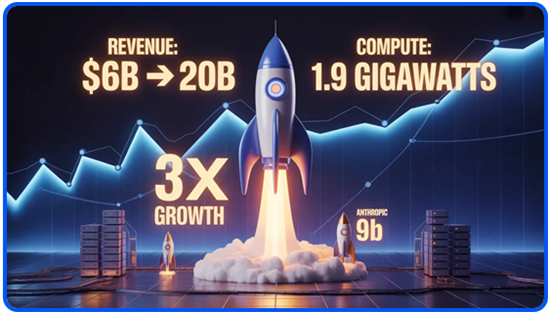
Brief Buzz: OpenAI is pushing back on talk of an AI slowdown with eye-catching new numbers. Fresh disclosures show explosive revenue growth and massive investment in computing power - signaling that demand for AI tools is still accelerating, not stalling, as outlined in OpenAI's post on building a business that scales with intelligence. - Annual recurring revenue jumped 3×, from $6B in 2024 to $20B in 2025, reflecting how OpenAI says its model scales with the value of intelligence
- Compute capacity grew 3.5×, reaching ~1.9 gigawatts, easing one of AI's biggest bottlenecks
- CFO Sarah Friar described this as "never-before-seen growth at such scale"
- 2026 focus shifts to "practical adoption" in health, science, and enterprise
- OpenAI now outpaces rival Anthropic, which is targeting nearly $9B in annualized revenue by the end of 2025, according to Reuters' reporting on Anthropic's growth plans
Why Should You Care?
This shows AI is hardening into core infrastructure, not a passing trend. OpenAI is betting big on scale, while Anthropic is taking a different path - backed by its Series F funding round and a $50 billion commitment to U.S. AI infrastructure. For everyone else, that competition means faster improvements, broader adoption, and AI tools that increasingly show up in everyday work and life. | | ⚡️ 5 AI Tools to Supercharge Your Productivity 👉 Paychex - delivers AI powered conversational HR and payroll support, AI driven recruiting for candidate matching, predictive analytics for workforce trends, and generative AI insights via natural language queries, enabling automation and faster data informed decisions. 👉 Human Interest - The platform uses AI-driven compliance intelligence to continuously monitor regulatory requirements, automatically flag anomalies, and reduce the administrative burden associated with plan oversight. 👉 Teramind - delivers a comprehensive suite for insider threat prevention and employee monitoring. It enhances security through behavior analytics and data loss prevention, ensuring compliance and optimizing business processes. 👉 SlickText - An SMS marketing tool with AI Compose built into campaigns, workflows, and auto-responses that generates editable message drafts from simple prompts, plus AI-enabled customer segmentation and opt-out intelligence to personalize messaging at scale. 👉 CapFront - This small-business funding marketplace uses "innovative technology" including machine-learning and AI-driven analytics to assess credit risk more quickly and accurately, enabling faster approvals and streamlined underwriting. | | 📈 How Anthropic's New Economic Index Helps Explain 2026 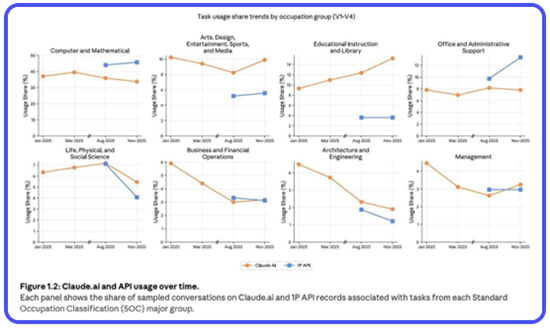
Brief Buzz: Anthropic's latest Economic Index analyzed 2 million Claude chats and found a clear pattern: AI is mostly working with humans, not taking their jobs. Productivity gains are real and accelerating - but full automation remains limited. - AI now helps with ~25% of tasks in nearly half of all jobs, up from 36% last year
- Full job replacement stays under 10% of companies
- Harder tasks benefit more: 9× speedups for high-school level work, 12× for college-level tasks
- Claude successfully handles long tasks up to 19 hours, hitting a 50% success rate
- Coding still dominates, but collaboration (learning, feedback, iteration) now beats pure automation
- Dive deeper in Anthropic's latest Anthropic Economic Index
Why Should You Care?
AI isn't replacing most workers - but it is quietly reshaping how careers begin. If AI absorbs the "grunt work" that once trained junior employees, the next generation may face fewer on-ramps to experience - changing hiring, education, and career growth faster than many expect. | | 🚀 Google's New Open Standard Could Transform How We Shop Online 
Brief Buzz: Google just unveiled Universal Commerce Protocol (UCP)—an open-source standard designed to make AI-powered shopping smoother, faster, and more secure. Built with major retailers, it gives AI agents a shared "language" to discover products, check inventory, and complete purchases—all inside a single conversation. - Google launched UCP as an open-source standard for agentic commerce
- Developed with Shopify, Etsy, Wayfair, Target, and Walmart
- Creates a single integration layer instead of custom connections for every app or AI surface
- Supports real-time inventory, dynamic pricing, and instant checkout
- Built with security first, using tokenized payments and verifiable credentials
- Read the deep dive on Google's official blog
Why Should You Care?
Because this could make shopping with AI actually seamless - from idea to checkout - cutting friction for consumers while helping businesses plug into future AI shopping experiences without rebuilding their tech stack. | | 🏗️ Meta's $600B Bet on AI Infrastructure 
Brief Buzz: Meta just unveiled Meta Compute, a massive push to build AI infrastructure at a scale few companies can match. The move signals that the AI race is no longer just about smarter models - it's about who can power them. The initiative was outlined directly by Mark Zuckerberg in a recent announcement. - Plans to add tens of gigawatts of compute this decade, scaling to hundreds of gigawatts over time
- Led by infrastructure chief Santosh Janardhan with Daniel Gross, formerly of AI safety startup SSI
- $600B committed to U.S. infrastructure by 2028, backed by long-term nuclear power agreements
- Government partnerships overseen by new Meta president Dina Powell McCormick
- Announcement coincides with reported layoffs in Reality Labs, as Meta shifts away from metaverse bets (Bloomberg report)
Why Should You Care?
AI's future depends on massive computing infrastructure, not just better code. Meta's bet could accelerate AI features you use daily - from assistants to creative tools - while raising big questions about energy use, costs, and who controls the most powerful AI systems. | | 📉 AI Buzz Around Claude Code Spooks Software Investors 
Brief Buzz: Anthropic's Claude Code is having a viral breakout, with developers and founders using it to build serious software at lightning speed. The excitement is spilling into Wall Street, where investors are suddenly questioning the future of traditional software businesses, as detailed in a Wall Street Journal deep dive on Claude Code's rise.
Why Should You Care?
If AI can build custom software on demand, expensive subscription tools may lose their grip. That could mean cheaper software, faster innovation, and a future where everyday people - not just engineers - can turn ideas into working products. | | 📸 AI Generator Images: Utopian City 
Midjourney Prompt: A hyper-detailed utopian version of Istanbul [or another city of your choice]; enormous futuristic structures inspired by Ottoman-Byzantine architecture, gigantic column-based megastructures rising over the city, domes and minarets redesigned in advanced crystal-metal composites. Ultra-complex patterns carved into every surface: illuminated arabesque motifs, gold-infused filigree lines, geometric mosaics, holographic calligraphy flowing across the buildings. Massive bridges and skywalks connecting colossal towers, reminiscent of the Bosphorus but transformed into an elevated, multi-layer energy river. The ground level is a bustling urban plaza filled with hundreds of people, diverse clothing styles blending futuristic fabrics with traditional silhouettes; vibrant crowds, dynamic movement, street vendors, floating lanterns. Atmosphere filled with soft morning haze over the futuristic skyline; sunlight breaking through gigantic columns, domes glowing with internal energy. Wide-angle cinematic shot, extreme detail, 8K realism, deep perspective, intricate textures everywhere. Negative: no blur, no distorted faces, no extra limbs, no low-quality details, no broken architecture, no warped perspective, no watermark. --ar 9:16 --style raw | |
|
