 Welcome to Guru99 AI Report! Together With 👉 Campaign Monitor 👈 | Monday top story This week brings a clear look at how AI is reshaping work, creativity, and decision-making. I’ve pulled together the most useful shifts, surprises, and signals you should know. A few of them might change how you think about AI today. | 📰 AI Agents Explained: What They Actually Do 
Brief Buzz: The AI industry lacks consensus on what "AI agents" actually are, creating confusion for teams trying to deploy them. Without shared definitions, it’s hard to set expectations, measure performance, or manage risk. Here's what's emerging to bring order to the chaos: - Capability spectrum: AI agents range from basic task-executors (handling FAQs) to sophisticated multi-step operators (sales agents that research, email, and schedule independently)
- Three helpful frameworks: capability levels (execution → autonomy), human–AI collaboration levels (aviation-inspired, see SAE automation levels), and accountability when things go wrong.
- The "centaur model" is becoming the gold standard - AI handles scale and speed while humans drive strategy, similar to self-driving car automation levels
- Teams must address hallucinations, misalignments, and legal risks before deployment. Full story on FT
Why Should You Care?
Without clear definitions, businesses risk deploying AI systems they don't fully understand - potentially automating the wrong tasks or creating accountability nightmares. These frameworks give you a common language to evaluate AI tools, set realistic expectations, and avoid expensive mistakes. Whether you're considering an AI assistant for customer service or sales automation, understanding where it falls on the autonomy spectrum helps you choose the right tool and maintain proper oversight. Think of it as reading nutrition labels before changing your diet - essential information for making informed decisions about what enters your business operations. 👉 Compare the best AI chatbots built for results | | 👉 In partnership with Campaign Monitor 
Campaign Monitor is a cloud-based email marketing platform designed to help businesses create, send, and optimize professional email campaigns. It offers intuitive drag-and-drop design tools, audience segmentation, and detailed analytics to help marketers build stronger connections with their subscribers. Campaign Monitor's AI-driven capabilities have further enhanced its effectiveness in modern marketing. Through the use of artificial intelligence and machine learning, the platform helps businesses send more personalized and timely messages, improving engagement and conversion rates. AI is deeply integrated into Campaign Monitor’s automation, optimization, and reporting systems, allowing marketers to make smarter, data-backed decisions about their email strategies. - Smart Email Automation: Uses AI to send emails at optimal times with personalized content for higher engagement.
- AI-Enhanced Reporting and Insights: Uses AI to analyze performance, identify trends, and recommend improvements for optimized marketing results.
| | 💡 How OpenAI Outsmarted Data Labeling Rules 
Brief Buzz: OpenAI's secretive Project Mercury is taking a bold turn in AI training - hiring over 100 ex–Wall Street bankers instead of traditional data annotators. These former JPMorgan, Goldman Sachs, and Morgan Stanley analysts, reportedly earning $150/hour, are crafting prompts and financial models to teach AI how real-world finance works. - Marks a shift from low-cost annotation to elite, domain-specific expertise.
- Aims to produce higher-quality financial datasets for more capable AI models.
- Could disrupt the $3.77 billion data labeling industry, challenging players like Scale AI and Surge AI.
- Reflects a broader trend toward vertical integration - cutting out middlemen to tighten control over data quality.
- Experts caution that scaling such human-led precision remains a technical and operational challenge, as noted by Surge AI's Edwin Chen.
Why Should You Care?
This move highlights how the future of AI training is becoming more specialized and premium. If OpenAI’s approach works, it could mean smarter AI systems that truly understand complex domains like finance or law. But it also raises questions: Will AI become a game only the richest companies can afford to play? 👉 How to Fix the Network Error in ChatGPT? | | ⚡️ 5 AI Tools to Supercharge Your Productivity 👉 Intelogos - This workforce analytics and remote-employee monitoring platform explicitly uses AI to generate performance - based suggestions, identify potential burnout, analyse efforts & productivity, and summarise long reports. 👉 SBG Funding - Although primarily a small-business lender, SBG Funding publishes guidance on how its clients are using AI and ML tools for growth — and by extension SBG helps finance adoption of such AI-driven tech. 👉 Xero - AI-powered features streamline financial management by automating tasks like invoice processing and bank reconciliation. Its predictive analytics provide actionable insights, helping businesses forecast cash flow and make data-driven decisions effortlessly. 👉 CapFront - This small-business funding marketplace uses “innovative technology” including machine-learning and AI-driven analytics to assess credit risk more quickly and accurately, enabling faster approvals and streamlined underwriting. 👉 Bambee - leverages AI to provide personalized HR guidance for small to mid-sized businesses. Its AI-driven features include automated compliance tracking, customized HR policy recommendations, and intelligent issue resolution support. The tool learns from user interactions to improve HR solutions over time. | | 🧩 What's Really Shaping Generative Media? 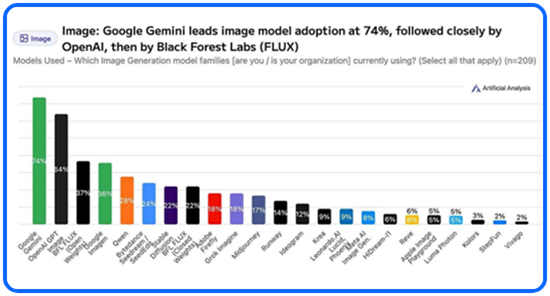
Brief Buzz: AI is officially reshaping creative workflows — fast. A new State of Generative Media 2025 report from Artificial Analysis surveyed 300 developers and creators, revealing how deeply generative tools have embedded into daily work and where Google is stealing the spotlight. - Google dominates: Gemini leads with 74% of AI image use, while Veo claims 69% of AI video creators, outpacing OpenAI and Midjourney.
- Widespread adoption: 89% of personal creators use AI image tools, though video adoption trails at 58% — but it’s climbing fast.
- ROI is real: 65% of organizations saw returns within a year; 34% already report profits from AI media projects.
- Different priorities: Individuals value quality (76%), while enterprises focus on cost savings (57%).
Why Should You Care?
If you thought generative AI was still experimental, this report says otherwise. From creators earning faster returns to Google overtaking OpenAI in creative AI, the message is clear: AI-generated media isn't the future - it's the present, reshaping how content, marketing, and storytelling are made. 👉 Drive real results with unified media management | | 🕵️ Inside Amazon's Next Big Move 
Brief Buzz: Amazon is gearing up for an AI-powered overhaul of its vast logistics empire. According to The New York Times, the company aims to automate up to 75% of its operations by 2033, potentially replacing hundreds of thousands of roles with advanced robotics. - Amazon's internal plans suggest avoiding 600,000 hires through automation, with 160,000 roles phased out by 2027.
- The move could save $12.6 billion between 2025 and 2027, or about 30 cents per item sold.
- Amazon says automation will also enable expansion into new areas and reskill employees for future-ready jobs.
- The company maintains the leaked documents reflect only one team’s plans, not its overall strategy, and still intends to hire 250,000 workers for the holiday season.
- Similar AI-driven workforce shifts are happening at Lufthansa, Klarna, Salesforce, and Accenture — with Klarna, Salesforce, and Accenture already citing AI as a key driver behind major layoffs.
Why Should You Care?
This is a glimpse into the future of work. As AI and robotics take over repetitive tasks, companies will see major efficiency gains - but workers may face disruption and the urgent need to reskill for an automated economy. Amazon’s plan underscores how AI’s biggest impact might not be new products—but new job realities. | | 🛠️ How to Build Multi-Agent Apps Easily 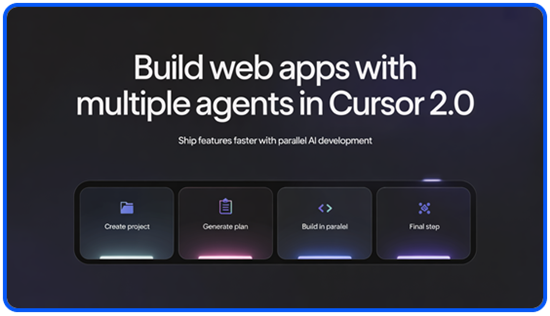
In this tutorial, you'll learn how to leverage Cursor 2.0's powerful multi-agent feature to develop web applications faster by assigning different AI agents to work on separate parts of your project simultaneously. Step-by-Step Guide - Create a new folder named "todo-list-app", then open the Cursor application. Click "Open Project" and select your folder (or simply drag and drop it into the Cursor IDE).
- Click "Agents" button, then "New Agent" and prompt: "Create a plan to build a To-Do app using Next.js as Plan.md. Divide tasks for two dev agents working in parallel, and include integration steps and README"
- Once Plan.md is created, accept it. Then, click "New Agent" twice: For the first agent, prompt: "Start Dev 1 tasks from Plan.md." and second agent, prompt: "Start Dev 2 tasks from Plan.md." Review and accept changes from both agents.
- Next, instruct one agent: "Complete integration from Plan.md, update README with run instructions." Then, open the terminal and run the commands: npm install, followed by npm run dev
- Visit http://localhost:3000 to view your completed To-Do app, collaboratively built by multiple AI agents working simultaneously.
💡 Pro Tip: For a hands-free experience, use the Voice button on the prompt bar. Simply speak your prompt and say "submit" at the end to send it automatically - perfect for multitasking while coding! 👉 Shape your future with product management | | 💻 Prompt of The Day: Personal Strategizer Prompt: Act as a strategic consultant skilled in scenario planning and long-term forecasting. I want you to help anticipate possible futures for [specific goal or project]. Begin by identifying the key internal and external factors that could influence the outcome—such as technology, market trends, competition, regulation, economy, or team capability. Then, outline three detailed future scenarios: a best-case scenario where everything goes better than expected, a most-likely scenario based on current trends, and a worst-case scenario where major challenges or disruptions occur. For each scenario, describe the key triggers or early warning signs, potential risks and opportunities, and the strategic actions that could be taken in response. Finally, provide overall recommendations on how to stay resilient, adaptable, and strategically prepared across all possible futures. | | 📸 AI Generator Images: Games 
| |
|
