| 👉 In partnership with Teramind 
Teramind AI-driven User & Entity Behavior Analytics (UEBA) learns a baseline for every user and device with machine-learning models, then scores risk whenever live activity deviates.This automated profiling highlights abnormal log-ons, data access, or workflow shifts so security teams see emerging insider threats before policy rules even fire. Deep-learning algorithms stream-scan keystrokes, clipboard events, screen pixels, and file moves, issuing predictive alerts or automatically blocking exfiltration seconds in advance. Real-time anomaly detection cuts through noise, letting analysts focus on the few AI-flagged sessions that matter most. Teramind also "monitors the monitors": it recognizes ChatGPT, Gemini and other LLM sessions, parses prompts and outputs with NLP content inspection, and quarantines anything that resembles sensitive data. Dashboards quantify enterprise AI adoption and surface risky usage patterns, giving managers the insight to foster safe, productive generative-AI workflows. - Generative-AI content guardrails: NLP engines inspect ChatGPT/Claude prompts and outputs on the fly, flag unusual usage and quarantine sensitive text to enforce DLP.
- Predictive workforce insights: Teramind's AI engine fuses hundreds of behavioural signals to surface disengagement trends, hidden leaders and early insider-threat cues.
| | 🚀 Microsoft Eyes Bringing AI Off the Screen and Into Reality 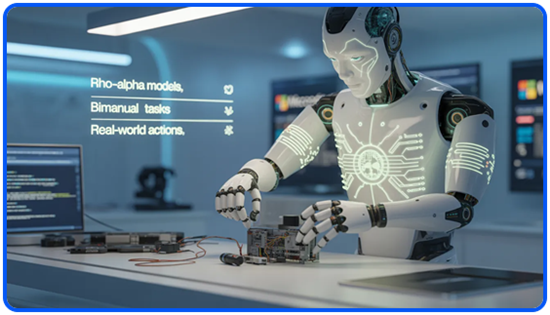
Brief Buzz: AI is learning how to move, feel, and act. Microsoft has unveiled its first major step into Physical AI, aiming to bring advanced reasoning from screens into real-world machines. - Microsoft's new Rho-alpha robotics models turn spoken commands into real-world actions, including two-handed (bimanual) tasks.
- Built on the Phi AI model family, with added tactile sensing like force and touch.
- Robots can learn from human feedback on the job, improving over time.
- Training uses real demos, simulations, web data — plus synthetic environments via NVIDIA's open-sourceIsaac Sim.
- Developers can apply via Microsoft's Research Early Access Program (sign-up link).
This follows a broader industry push, including NVIDIA's Physical AI push at CES, where CEO Jensen Huang called it "the ChatGPT moment for robotics" (ZDNet coverage).
Why Should You Care?
Physical AI could mean robots that adapt to people and environments safely, not just pre-programmed machines. Think smarter factories, safer healthcare assistants, and helpful home robots. If AI can reason and act in the real world, its usefulness could finally catch up with the hype. 👉 Start Microsoft Courses Today Free | | ⚡️ 5 AI Tools to Supercharge Your Productivity 👉 Paychex - delivers AI powered conversational HR and payroll support, AI driven recruiting for candidate matching, predictive analytics for workforce trends, and generative AI insights via natural language queries, enabling automation and faster data informed decisions. 👉 Human Interest - The platform uses AI-driven compliance intelligence to continuously monitor regulatory requirements, automatically flag anomalies, and reduce the administrative burden associated with plan oversight. 👉 Salesforce - offers a suite of AI-powered tools designed to enhance customer relationship management (CRM). With Einstein AI, it provides intelligent insights into customer behavior, automates data entry, and personalizes marketing efforts. 👉 Zendesk - AI features streamline customer support with advanced tools like AI-powered chatbots for instant query resolution and natural language processing for intelligent ticket routing. It provides sentiment analysis to prioritize issues effectively, enhancing customer satisfaction. 👉 OnPay - utilizes cutting-edge AI to automate payroll calculations, minimizing errors and ensuring regulatory compliance effortlessly. Its machine learning algorithms analyze employee data to provide predictive insights and optimize workforce management. | | 😴 Stanford AI predicts 130 diseases from a night's sleep 
Brief Buzz: A research team from Stanford University unveiled SleepFM, an AI "foundation model" that turns a single night of sleep into a powerful health forecast—spotting early signs of serious disease years before symptoms appear. The findings were published in Nature Medicine. - Trained on 600,000 hours of sleep data from 65,000 people, analyzing brain waves, heart activity, breathing, and muscle signals.
- Detects out-of-sync body signals (like deep sleep paired with a racing heart) as early warning signs.
- Validated using 25 years of Stanford Sleep Clinic records across 1,000+ diseases.
- Delivered high accuracy: Parkinson's (89%), dementia (85%), heart attacks (81%), and overall mortality risk (84%).
Why Should You Care?
Because your sleep may reveal health risks long before symptoms show up. As wearables get smarter, tools like SleepFM could shift early disease detection from specialized sleep labs to everyday devices, helping people catch serious conditions sooner - and potentially save lives while lowering healthcare costs. | | 🧠 Alibaba Expands Qwen Into a Unified AI Super-App 
Brief Buzz: Alibaba just supercharged Qwen (Tongyi Qianwen)—turning it from a chatbot into a full-blown AI personal assistant for daily life. As of mid-January 2026, the move signals a sharp pivot toward consumers, putting Alibaba in direct competition with China's hottest AI apps. - Alibaba positions Qwen as a consumer "super-app" AI, not just enterprise tech.
- Multimodal life assistant handles text, images, audio, and video—and can order items or pay bills via Taobao and Alipay.
- Powered by Qwen3, offering stronger reasoning, tool use, and long-context (128K tokens).
- Advanced features include deep research, coding, image & video generation, and travel planning.
- Rapid growth: 100M+ users, climbing app-store rankings, and gearing up to challenge ByteDance's Doubao and DeepSeek.
Why Should You Care?
This is a glimpse of where AI is headed: one app that thinks, plans, pays, and acts for you. If Qwen succeeds, AI assistants won't just answer questions—they'll run everyday life, redefining how people shop, travel, and get work done. 👉 Game-Changing ClickFunnels Alternative Super App | | 🤔 AI Sounds Amazing - So Why Aren't We Using It That Way? 
Brief Buzz: A new large-scale study reveals a surprising truth about how people really use AI. Instead of work productivity, most interactions are deeply personal - signaling that AI's biggest adoption wave is happening at home, not the office. - 55% of AI queries are personal, vs 30% professional, according to research from Perplexity and Harvard University, detailed in How people use AI agents.
- Findings align with OpenAI data showing 70% of ChatGPT use is non-work-related, explained in How people are using ChatGPT.
- Users increasingly treat AI as a personal concierge, not just a workplace assistant.
- This mirrors the early PC revolution, which began with home use before dominating offices.
- The strongest AI adoption momentum is happening outside the enterprise.
Why Should You Care?
Because AI is reshaping everyday life first - organizing plans, answering personal questions, managing routines - before transforming jobs. The AI habits you build at home today may quietly become essential workplace skills tomorrow. 👉 Clone Voices with AI Effortlessly | | 🔍 How to Practice Case Interviews the Right Way - with Feedback That Helps 

- Upload your case study so Claude can extract all key data. (Enable 'Extended Thinking' for deeper analysis).
- Tell Claude your goal, and ask it to build a spreadsheet model with formulas and core frameworks.
Sample Prompt: I'm practicing for consulting interviews. Set up this practice scenario for me using the case I've uploaded, extract the data into a spreadsheet model with formulas and frameworks. Then, tell me what questions I should focus on. After I finish my analysis and write my recommendation, I'll share it for feedback. Review it like a senior partner would: check my numbers, evaluate my logic, and tell me specifically what needs improvement. - Let Claude generate your practice guide, including key questions, required analyses, and what to prioritize.
- Once you're done, ask follow-ups to refine your approach, compare alternative solutions, dive into specific frameworks, or request a tighter review of your work.
💡 Pro Tip After Claude creates the spreadsheet model, ask it to list the 3–5 most sensitive assumptions (the ones that change the outcome the most) and suggest quick "sanity checks" you can do on each - this mirrors how interviewers evaluate judgment under time pressure. | | 📸 AI Generator Images: Games 
| |
|


